The SaaS Capital Index
Public company data is the best starting point when valuing a private Software-as-a-Service (SaaS) business, so we created the SaaS Capital Index™ to be the most accurate, up-to-date valuation tool for pure-play, B2B, SaaS businesses.
The SaaS Capital Index™ is designed to be used in combination with the white paper What’s Your SaaS Company Worth? as the starting point for comprehensive valuation analysis.
Data as of: 06/30/26
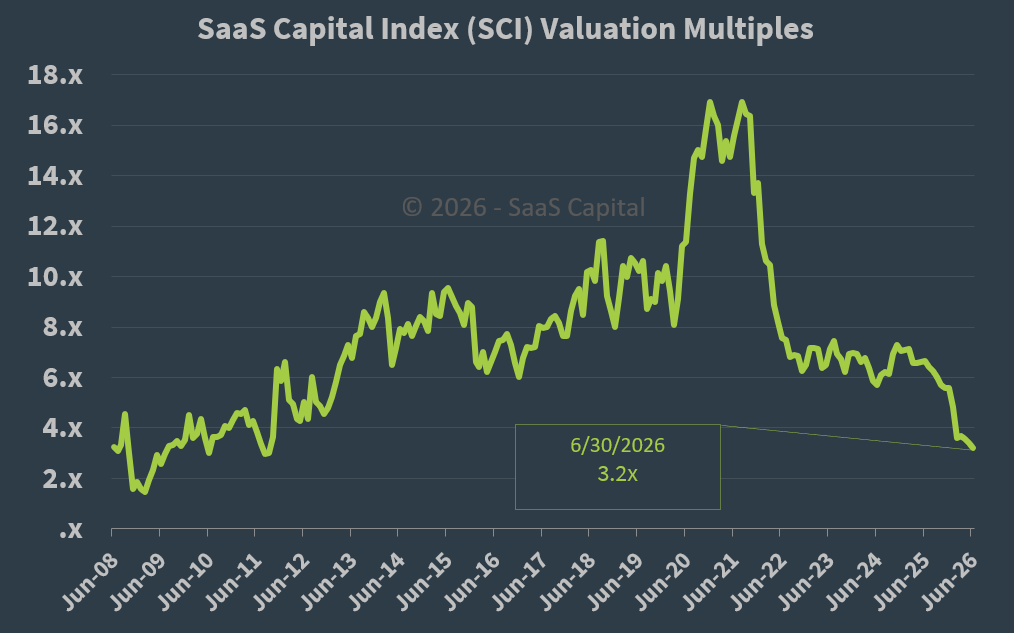
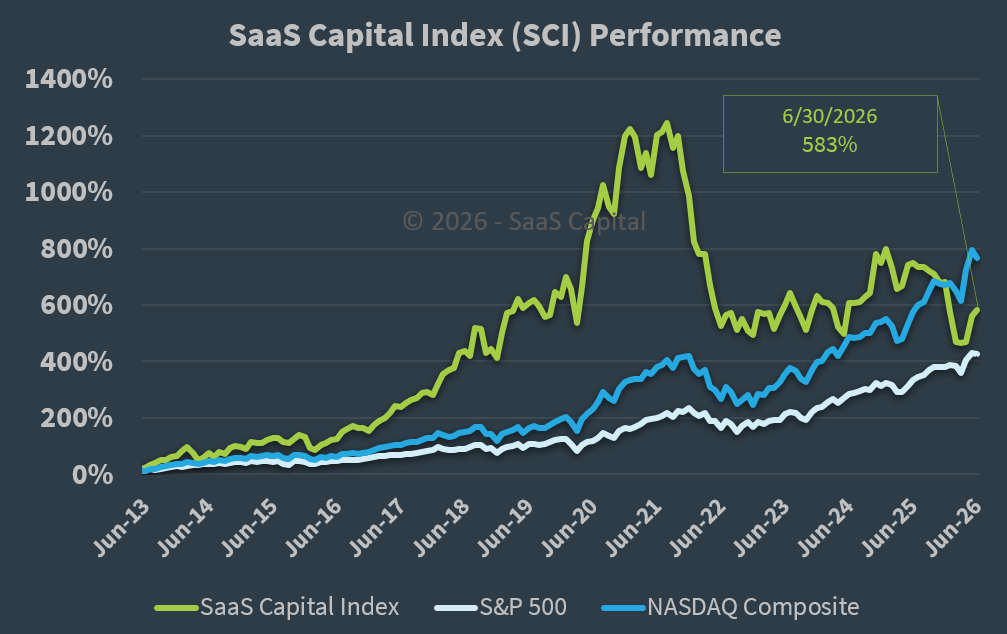
The SaaS Capital Index™ differs from other SaaS stock indices in the following ways:
- The revenue multiple is based on annualized current run-rate revenue, not trailing or projected revenue. We believe run-rate revenue is the most accurate and objective measure of the current scale of the business and, therefore, the best measure to be used for valuation purposes.
- The index excludes SaaS companies serving B2C customers and very small B2B companies with annual revenue per customer of less than $500. Companies targeting these end users have customer acquisition and retention dynamics that are significantly different than those of traditional B2B SaaS businesses. Examples of excluded SaaS companies in this category include Box, Dropbox, Carbonite, and 2U.
- SaaS business with “mixed” revenue streams, which include significant amounts of perpetual or maintenance revenue, hardware sales, telecom minutes, or other “non-SaaS” revenues, are excluded. The gross operating margins, cost structures, and revenue volatility of these companies do not fit the traditional SaaS model. Examples of excluded companies in this category include Oracle, Microsoft, Square, and Twilio.
- SaaS consolidators such as Constellation Software are also excluded for a variety of business model reasons.
We compiled the SaaS Capital Index™ for the first time in Q3 2019, and while the historical data goes back many years, it only includes data from active SaaS businesses in Q3 2019. Since Q3 2019, however, we have added new qualifying SaaS companies as they have gone public. Acquired or delisted companies remain in the historical data.
Comments and questions about the SaaS Capital Index, can be sent here.
Sign up below to be notified each month when the SaaS Capital Index™ is updated.
Frequently Asked Questions
What is the SCI?
The SaaS Capital Index is a curated group of companies, about which we publish certain data on a monthly basis. The most-used data point is the median Valuation Multiple, which is a single monthly number that reflects current investor sentiment about the SaaS industry. We often informally use the term “the SCI” or “the current SCI level” to refer to this single monthly number, the median Valuation Multiple.
What companies are included in the SaaS Capital Index?
There are currently 63 publicly-traded companies in the SCI. All must be listed on U.S.-based stock exchanges, but they do not need to be physically located in the US. All are companies that we judge to be primarily valued on B2B recurring software revenue models. We examine all new IPOs in the US for inclusion as soon as they are listed; when in doubt, we leave it out.
Does the Index composition change? What happens if a company is bankrupt or goes private?
Companies are added and removed regularly; however, we never change previously-published data.* That means if a company goes private or is absorbed in a merger, we will no longer report it as a component of the index going forward, but we leave its data in the historical table. If a ticker changes, we will change the ticker only and keep the historical and new data together under the new ticker. (*If data is unavailable at publication time, we include a “#VALUE” error at that time, and back-fill subsequently when data become available.)
What are the data elements published for the Index?
Primary data elements are Revenue, Profit, and Market Cap. Ratios such as the valuation multiple are derived from the primary data elements.
What is the source of the primary data?
Primary data elements are derived from company-reported data on their 10-Q forms as required by the SEC. We historically used Yahoo! Finance prior to 2024, and we currently use the Tiingo financial data API. However, the actual numbers are generated by the companies.
How are Revenue, Profit, and Market Cap defined?
Revenue is all reported GAAP revenue, from whatever source. Profit is reported GAAP net income. Revenue and Profit are converted from the most recent quarter’s number to monthly by simple division (divided by three). Market Cap is total market capitalization, float times closing share price, on the last day of the month. We do not adjust for cash or debt.
How is the Valuation Multiple (ARR Multiple) calculated?
The Valuation Multiple for each index component is the current Market Cap divided by annualized current run-rate revenue (most recent monthly Revenue times twelve). Because the Market Cap is updated monthly, the Valuation Multiple can change within a quarter even though the Revenue estimate does not.
Why is the Median ARR Multiple reported?
The median is a good measure of central tendency in this case. Using the mean (average) would be more subject to skew by extremes. Because there has historically usually been between 50-100 components in the index, there have been ample data points to use for calculating the median.
Why aren’t retention figures like Net Revenue Retention or Gross Revenue Retention part of the data?
Retention figures like NRR and GRR are not standard GAAP measures and reporting them is not required by the SEC; therefore they are not present for all index components. Furthermore, companies almost never publish the detailed customer revenue figures necessary to properly re-calculate retention. We caution against comparing any two companies’ self-published retention figures; the only way to make a meaningful comparison is to get customer revenue detail and re-calculate retention in a consistent manner.